The Pattern: Astrology
- 4.0
- Rating
- 1.00M
- Installs
- Free
- Price
 Analysis by App-foxy
I approached The Pattern as a daily self-reflection app rather than a conventional horoscope feed. Its focus is astrology, but the experience is less about reading a short prediction for the day and more about exploring personality, emotional tendencies, relationships, and recurring life themes. That difference matters: I found it most useful when I treated the app as a prompt for thinking, not as an authority that should make decisions for me.
Developed by Pattern Home, Inc., this free lifestyle app is available for users aged Teen and has built a sizeable audience, with over a million installs. Its average rating sits at 3.8 from around twenty-five thousand ratings, alongside roughly seven thousand reviews. Those figures suggest a product that connects strongly with many people while also leaving room for frustration, especially among users who expect every feature or insight to be available without payment.
The Pattern runs on Android eight and later, and the current version is 5.23.0. Optional purchases range from $8.99 to $83.99 per item, so the free starting point is useful, but anyone planning to explore the deeper paid side should pay attention before confirming a purchase. My overall impression is that this is a thoughtful astrology companion for people who enjoy examining themselves and their relationships, but it is not the best choice for someone looking for quick, concrete forecasts or a purely entertainment-focused horoscope.
You May Also Like

 Blood Strike: 2.5 Anniversary
Blood Strike’s Loadouts Turn Every Drop Into a Tactical Gamble
A close look at Blood Strike’s custom loadouts: how fast access to signature weapons reshapes its battle royale rhythm, rewards preparation, and narrows the gap between fights.

 Pandora - Music & Podcasts
Pandora’s Music Is Easy to Start, but Harder to Recover
Pandora’s strength is its low-effort path from a seed to a station. Its weak spot is how much confidence it asks you to place in connection, setup, and quiet recovery.

 8 Ball Pool
 Is Built on Rivalries, Rematches, and Routine
A close look at the rivalries, rematches, shared routines, and unanswered safety questions that turn a quick pool match into a persistent mobile community.

 Samsung Music
’s Quiet Strength Is Playing What You Already Own
Its reach comes less from spectacle than from dependable access to a personal library. That simplicity is both the app’s strongest retention engine and its ceiling.

 AccuWeather: Weather Radar
AccuWeather Review: A Quick, Clear Forecast for Everyday Decisions
For everyday plans, the best forecast is the one you can understand quickly. AccuWeather makes rain timing, radar, and local conditions easy to act on, with a few trade-offs.

 Hill Climb Racing
Why Hill Climb Racing Still Turns Crashes Into One More Run
A tiny car, a bumpy hill and one more upgrade: Hill Climb Racing keeps resurfacing because its simple chaos makes every near-miss feel personal.
More From Our News Desk
View All News


How I used The Pattern from the first reading onward
I found it helpful to begin with one reading and notice how the app’s reflective style differs from a quick horoscope. This section follows that first impression into a repeatable routine, including how I decide whether an insight deserves more attention. From there, I’ll look at the small choices that keep regular use comfortable rather than overwhelming.
A calmer alternative to scrolling horoscope posts
The first thing I noticed is that the app encourages a slower kind of reading. Instead of presenting a stream of dramatic predictions, it frames astrology around personal patterns and emotional experiences. I could read an insight, pause, and compare it with what was actually happening in my day. That made the app feel more reflective than a typical horoscope widget or social-media astrology account.
My baseline routine was simple. I opened the app when I had a quiet moment, read the available material, and saved the parts that felt relevant in my own mind rather than immediately accepting every statement. This is important because the language can feel personal even when it is broad enough to apply to many situations. The best habit is to ask, “Does this describe something I have observed repeatedly?” rather than “Is this definitely true about me?”
That approach also makes the app more useful over time. A single reading can feel vague, but repeated themes become easier to evaluate when I compare them with real events. For example, if a passage discusses hesitation around change, I can think about whether I actually delay decisions, whether that happens only at work, or whether the current situation simply makes me cautious. The app supplies a starting point; the useful interpretation still comes from me.
Why accurate birth information matters
Astrology apps depend heavily on the information entered during setup, so I would not rush through the profile. A small mistake in birth details can affect the material the app presents, and that can make the entire experience feel inconsistent. I recommend checking the profile carefully before judging the quality of the readings.
This is also one reason I would avoid treating an account as a casual one-minute experiment. The more seriously I used the app, the more I wanted the basic information to be correct and the more I noticed whether the insights matched my own experiences. If you are testing it for a friend or family member, make sure they are comfortable sharing the details needed to create their profile. Astrology may be light entertainment for one person and a personal subject for another.
Using relationship material without turning it into a verdict
The relationship side is one of the more interesting reasons to try The Pattern. Comparing two people can give you language for discussing differences in communication, emotional reactions, or expectations. I can imagine using it before a difficult conversation, not to prove that one person is right, but to identify topics worth discussing more carefully.
There is a useful distinction between using a comparison to open a conversation and using it to label someone permanently. The former can be constructive; the latter quickly becomes limiting. If an interpretation suggests that two people respond differently under pressure, I would use that as a question: “Do we handle stress in different ways?” I would not use it as evidence that a relationship is destined to fail or that a friend cannot change.
This makes the app particularly suitable for curious couples, close friends, and people who enjoy discussing personality. It is less suitable for anyone who wants a definitive compatibility score or a simple yes-or-no answer about a relationship. The Pattern works better as a shared vocabulary than as a judge.
Settings and habits that make the experience easier to manage
I get more from the app when I choose a comfortable pace before opening it, rather than letting a compelling passage pull me into a long session. Here I focus on ways to keep the experience intentional, especially when personal or relationship material feels intense. The next section shifts from managing that pace to making each visit more focused.
Check the profile before exploring deeper material
My first practical recommendation is to review the account details and personal information before spending time interpreting the results. This is not an exciting step, but it prevents a common problem: blaming the app for strange readings when the underlying profile is incomplete or inaccurate.
I also suggest taking a screenshot or personal note of the most useful insights only if you genuinely want to revisit them. Copying everything defeats the purpose of the app and can create a large collection of statements that are difficult to evaluate. I got more value from keeping a small mental shortlist of recurring themes than from trying to archive every paragraph.
Decide how much astrology you actually want
The app can become absorbing because it touches identity, relationships, and personal history. Before using it regularly, I would decide whether I want a brief daily check-in or a deeper exploration session. That choice helps prevent aimless browsing, especially when the content starts to feel emotionally specific.
For a short routine, I would read one section and write down one practical question. If the insight concerns communication, the question might be whether I have been avoiding a conversation. If it concerns change, I might ask whether my resistance comes from fear, lack of information, or a reasonable concern. This turns a passive reading into an actionable reflection without pretending that astrology has supplied a complete answer.
For a longer session, I would compare several themes and look for contradictions. If one passage makes me feel unusually understood while another feels completely wrong, that is not necessarily a flaw. People behave differently in different settings, and a broad interpretation may fit one part of life but not another. Reading critically is more valuable than trying to force every statement to fit.
Be deliberate around paid content
The free entry point makes it easy to try the app, but the in-app purchase range is wide enough that I would not tap through payment screens casually. A person who enjoys the initial material may feel tempted to unlock more simply because the content is personal and intriguing. I recommend deciding what you want from the app first, then considering whether a purchase adds something meaningful to that goal.
This is especially important for users who only want occasional entertainment. If you open an astrology app once every few months, paying for deeper material may not offer much value. Someone who uses it as a continuing journaling prompt may see more reason to spend, but even then, the purchase should be judged by the quality and usefulness of the specific content, not by the emotional pull of a locked section.
Keep boundaries around sensitive decisions
I would never use The Pattern as the only basis for medical, financial, legal, or major relationship decisions. The app can help me name feelings or consider a recurring behavior, but it cannot replace professional advice, direct communication, or evidence. This boundary is not a criticism of the app; it is simply the responsible way to use any interpretive system.
For users who are prone to anxiety, repeated checking may also become unhelpful. If a reading makes you worry about an event that has not happened, closing the app and returning to observable facts is the better move. The most experienced use is not constant consultation. It is knowing when the app has prompted enough thought for one day.
Faster ways to find value without reading everything
When I have only a few minutes, I don’t try to cover every topic; I start with a real-life question and use the reading as a prompt. This section looks at how that selective approach can make the app more practical without treating its interpretations as proof. It also sets up a closer look at what this kind of astrology can and cannot do.
Use a question-led routine
A useful shortcut is to open the app with a specific question instead of browsing every available area. I might ask whether I am avoiding a decision, misunderstanding someone’s reaction, or repeating a familiar emotional response. Then I read only the material that appears relevant and compare it with the situation I actually face.
This prevents the common trap of finding a dramatic sentence and reshaping the entire day around it. It also makes the app easier to fit into ordinary life. A commuter with five quiet minutes can use one insight as a prompt, while someone with more time can return later for a deeper review.
Turn insights into small experiments
The strongest practical use I found was converting an interpretation into a low-risk experiment. If the app suggests that I withdraw during conflict, I can try stating one concern clearly instead of ending the conversation. If it highlights a tendency toward overthinking, I can set a short decision window and observe what happens. The result is more informative than simply agreeing with the reading.
This method also exposes weak interpretations quickly. If a suggested pattern never appears in my behavior, I do not need to keep defending it. I can treat it as an interesting possibility and move on. That kind of testing keeps the app grounded in daily experience and stops it from becoming a collection of labels.
Compare relationship readings with real conversations
When using the relationship features, I would read separately first and discuss together afterward. That gives each person room to decide what feels accurate before the other person’s reaction influences the interpretation. Then the comparison can become a conversation about habits, expectations, and misunderstandings.
A realistic example would be two partners preparing for a stressful week. One may prefer immediate discussion, while the other needs time alone before talking. If the app gives both people language for that difference, they might agree on a practical routine: a short pause followed by a specific time to reconnect. The value comes from creating that agreement, not from treating the compatibility material as a final explanation.
Use repetition as a filter, not as proof
One non-obvious advantage of returning to the app is that repeated themes can help identify what deserves attention. If the same kind of reflection keeps feeling relevant across different situations, I can investigate it through journaling or conversation. But repetition alone does not prove that the astrological explanation is correct. It may simply point toward a behavior I already recognize.
I found this filter more useful than chasing novelty. New readings can be entertaining, but recurring themes are where the app may become personally meaningful. I would rather understand one pattern well than collect dozens of impressive-sounding descriptions.
Where the app reaches its limits
The app’s personal tone can make its interpretations feel unusually convincing, so I think it is worth being clear about the boundary between reflection and evidence. This section considers situations where another tool or a direct conversation is more useful, and why the app’s strengths do not make it suitable for every need. That distinction leads naturally to my overall recommendation.
Personal language can feel more precise than it is
The Pattern’s main strength is also its main risk: the writing can feel intimate. When a passage seems to describe a private concern, it is easy to assume that the app has identified something uniquely true. I had to remind myself that emotional resonance is not the same as accuracy.
Users who prefer measurable explanations may find this frustrating. A conventional habit tracker can show whether I completed a task, while a mood journal can reveal how often I felt anxious. The Pattern offers interpretation rather than measurement. If your goal is to monitor sleep, exercise, spending, or symptoms, a dedicated tracking app is a better tool.
It is not a replacement for a full astrology consultation
Some astrology enthusiasts may want extensive chart analysis, technical explanations, or direct guidance from a professional astrologer. The Pattern is more approachable than that kind of consultation, but its convenience also means the experience is less personal and less interactive. It gives me material to explore on my own rather than allowing a specialist to ask follow-up questions and adapt the discussion.
That makes it a good introduction for curious beginners and a convenient companion for casual enthusiasts. It may feel too simplified for someone already deeply involved in astrology or seeking a detailed, traditional reading. In that case, a specialist or more technical astrology platform may be more satisfying.
Privacy and emotional comfort deserve attention
Any app centered on identity and relationships deserves a thoughtful approach to privacy and sharing. I would avoid handing my account to another person or entering someone else’s details without permission. Even when the material is presented as entertainment, the subjects can be personal.
I would also be careful when reading relationship interpretations during an argument. A tense moment can make a broad statement feel like confirmation of the worst possible conclusion. Waiting until emotions settle produces a fairer reading and a healthier conversation. This is one of those small usage choices that separates a reflective experience from an unhealthy one.
Free access does not mean unlimited value
Because the app is free to install, it is easy to assume the entire experience is designed for casual use without financial friction. In practice, the optional purchases mean that interested users should understand their own level of commitment. The app is worth trying without paying, but I would not recommend purchasing simply because a locked insight appears at an emotionally persuasive moment.
For many people, the free experience may be enough to decide whether this style of astrology fits them. If the initial material feels too general, more content may not solve the underlying problem. On the other hand, if the app already supports a consistent journaling or relationship routine, a carefully considered purchase may make more sense.
My verdict after building a repeatable routine
After using The Pattern as a reflective tool, I see why it has attracted a large audience. It presents astrology in a personal, readable way and gives users several routes into self-examination, especially through recurring themes and relationship comparisons. I appreciate that it can fit into a quiet morning, a private journaling session, or a thoughtful conversation with someone close.
My recommendation comes with a clear condition: use the reading as a question, not as a verdict. That mindset protects the useful part of the experience while reducing the risk of letting a broad interpretation control an important choice. The app is at its best when it helps me notice a behavior, test a new response, and talk more honestly with another person.
I would recommend it to people who enjoy astrology, personality reflection, and emotionally focused conversations. It is also a good starting point for someone who finds traditional birth-chart language intimidating but wants something more personal than a generic horoscope. The free installation makes experimentation easy, although the optional purchases deserve careful consideration.
I would suggest skipping it if you want objective tracking, guaranteed predictions, technical chart detail, or direct professional guidance. A mood journal, habit tracker, astrology specialist, or simpler horoscope app could serve those needs better. The Pattern is not a productivity system and it will not verify whether an interpretation is true.
For me, the most effective workflow is modest: keep the profile accurate, read with a specific question, test insights against real behavior, and discuss relationship material without using it as ammunition. That routine gives the app a practical place in everyday life without asking it to become more than it is. As a free lifestyle app from Pattern Home, Inc., it offers an engaging introduction to personalized astrology, provided I remain curious, selective, and willing to trust real-world evidence over an appealing paragraph.
FAQs for The Pattern: Astrology
01What is The Pattern Astrology app?
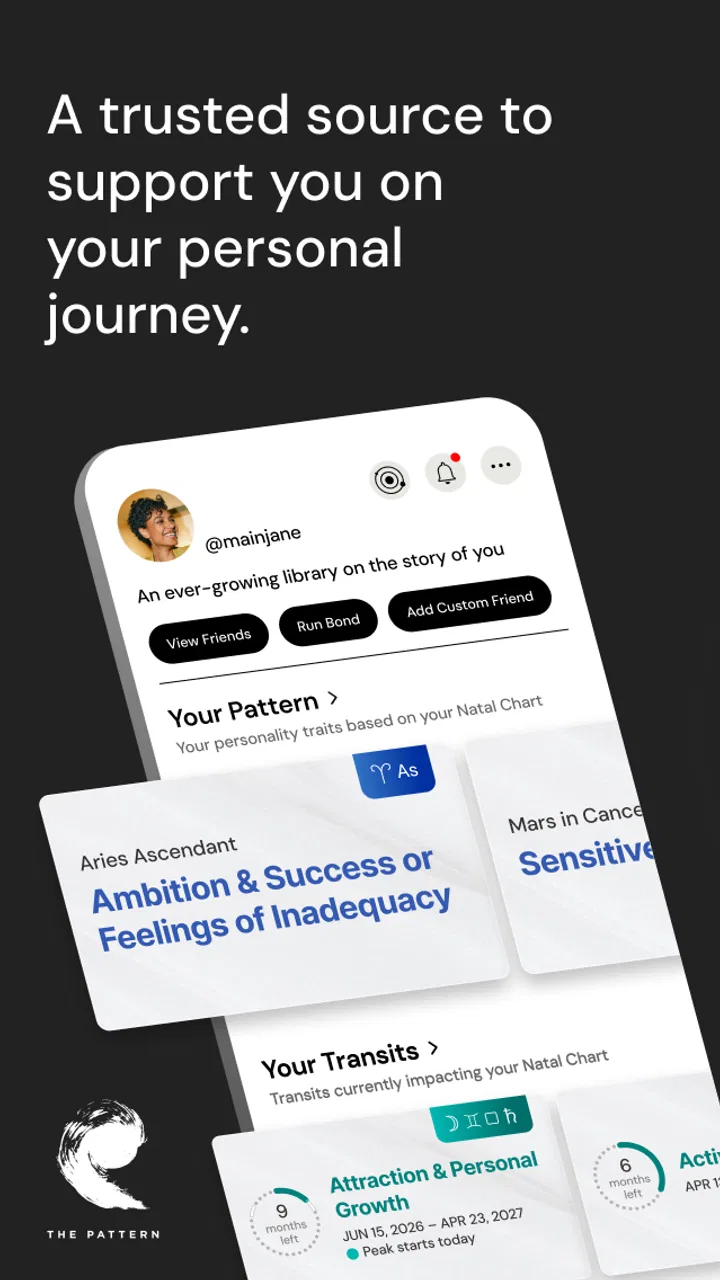
The Pattern Astrology app is a personality and astrology tool that provides insights into your personality traits, life patterns, and relationship dynamics based on your birth chart. It offers personalized readings and daily updates to help you understand yourself and others better.
02How does The Pattern Astrology app work?
The app uses your birth date, time, and location to generate a detailed birth chart. This chart is then analyzed to provide insights into various aspects of your life, including personality, emotions, and relationships. It offers both free and premium features for deeper exploration.
03Is The Pattern Astrology app free to use?
The Pattern Astrology app is free to download and offers a range of free features. However, it also provides premium subscription options for users who wish to access more in-depth analyses and additional features, such as compatibility reports and personalized notifications.
04Can I connect with friends on The Pattern Astrology app?
Yes, The Pattern Astrology app allows you to connect with friends by sharing your unique code. This feature lets you view your friends' patterns and compare them to your own, enhancing your understanding of your relationships and how you interact with one another.
05Is my personal data safe with The Pattern Astrology app?
The app takes privacy seriously and implements security measures to protect your personal information. It requires minimal data, primarily your birth details, to generate accurate readings. Always review their privacy policy to understand how your data is managed and protected.
Pros
- Highly personalized insights
- User-friendly interface
- In-depth relationship analysis
- Regular updates and features
- Free basic features
Cons
- Limited features without subscription
- Can be overwhelming for beginners
- Requires personal data for accuracy
- Occasional notification overload
- Compatibility issues on older devices

The Pattern: Astrology
Gallery